Why Indian Retailers Are Switching to ERP Systems in 2026
Introduction: Indian Retail Has Outgrown Manual Systems
Indian retail in 2026 looks nothing like it did five years ago.
From multi-city D2C brands to regional retail chains expanding through franchises, growth today is fast, fragmented, and unforgiving of inefficiency. Yet, many profitable Indian retailers still operate on disconnected systems - Excel for inventory, billing apps for sales, Tally for accounts, and WhatsApp for coordination.
The real problem surfaces when a business owner or CFO is asked a simple question:
“Where exactly are we leaking money?”
There is rarely a clear answer.
This is why Retail ERP systems in India are no longer seen as enterprise luxuries. In 2026, ERP has become a control layer helping brands gain visibility, compliance readiness, and decision clarity across locations.
This article explains why Indian retailers are switching to ERP systems in 2026, how ERP works in daily operations, and what decision-makers should evaluate before adopting one.
Table of Contents
Why Manual Retail Management Is Failing in 2026
Why 2026 Became the ERP Tipping Point in Indian Retail
What Is a Retail ERP System? (Beyond Billing)
How ERP Solves Real Retail Business Problems
ERP vs POS vs Tally vs Excel (What to Use and When)
ERP Use Cases by Retail Business Type
What Decision-Makers Should Evaluate Before Choosing ERP
Final Perspective: ERP Is a Leadership Decision in 2026
Why Manual Retail Management Is Failing in 2026
Most operational losses in Indian retail are invisible.
They do not appear as sudden failures but as daily inefficiencies that quietly compound.
Common issues seen across growing retail brands:
Inventory blind spots: No real-time view of stock across stores or warehouses
Dead capital: Slow-moving and expired inventory blocking cash flow
Billing leakage: Manual overrides, discount mismatches, return errors
Disconnected systems: POS, inventory, GST, and accounting working in silos
Delayed decision-making: Reports arrive weeks after the damage is done
In brands operating 5, 10, or 50+ outlets, even a 2–3% leakage per outlet translates into significant annual loss.
Manual systems cannot scale decision accuracy.
Why 2026 Became the ERP Tipping Point in Indian Retail
Several structural shifts converged to make ERP adoption unavoidable.
1. The Rise of the Phygital Indian Consumer
Indian consumers are now phygital they discover products online and purchase offline (or the reverse).
If a product promoted on Instagram or WhatsApp is unavailable at the store:
Trust breaks
The customer switches brands
Repeat visits decline
Modern retail ERP software in India synchronizes online and offline inventory in real time preventing this mismatch.
2. GST 2.0 and Compliance Pressure
By 2026, GST compliance requires:
Real-time invoice accuracy
Automated tax calculations
Ready-to-file reports for auditors and CAs
Month-end reconciliation through Excel or manual billing is no longer viable for growing businesses.
3. Expansion Without Process Maturity
Many Indian brands scaled faster than their systems.
ERP adoption in 2026 is less about technology and more about regaining control.
What Is a Retail ERP System? (Beyond Billing)
A billing app records transactions.
A Retail ERP system manages the entire operational lifecycle of a retail business.
Core ERP Modules Explained Simply:
Sales & POS: Unified billing across outlets with real-time sync
Inventory Management: SKU-level, batch-wise, expiry-wise tracking
Procurement & Purchase: Automated purchase orders based on reorder logic
GST & Compliance: Tax-ready invoicing and audit-friendly reports
Reporting & Analytics: Outlet-wise, category-wise, margin-level insights
CRM & Loyalty: Customer data used for targeted retention campaigns
Multi-Outlet Control: Centralized dashboards for distributed businesses
ERP converts raw data into operational intelligence.
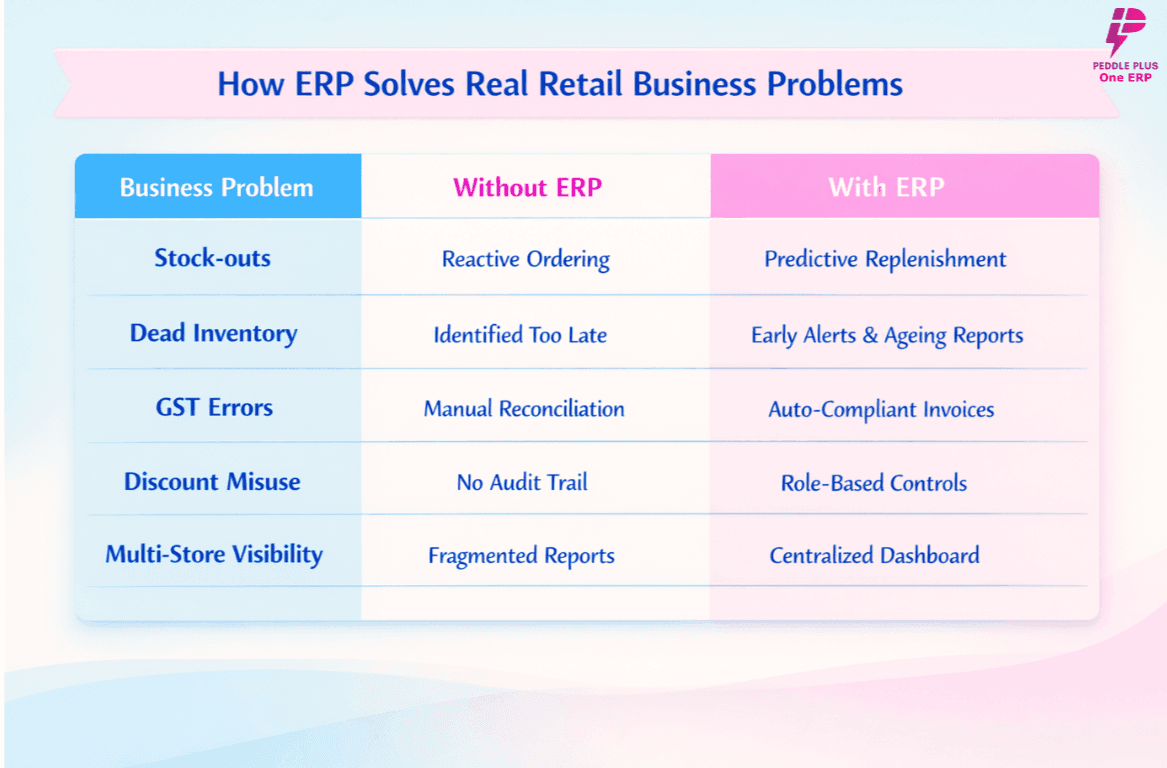
How ERP Solves Real Retail Business Problems
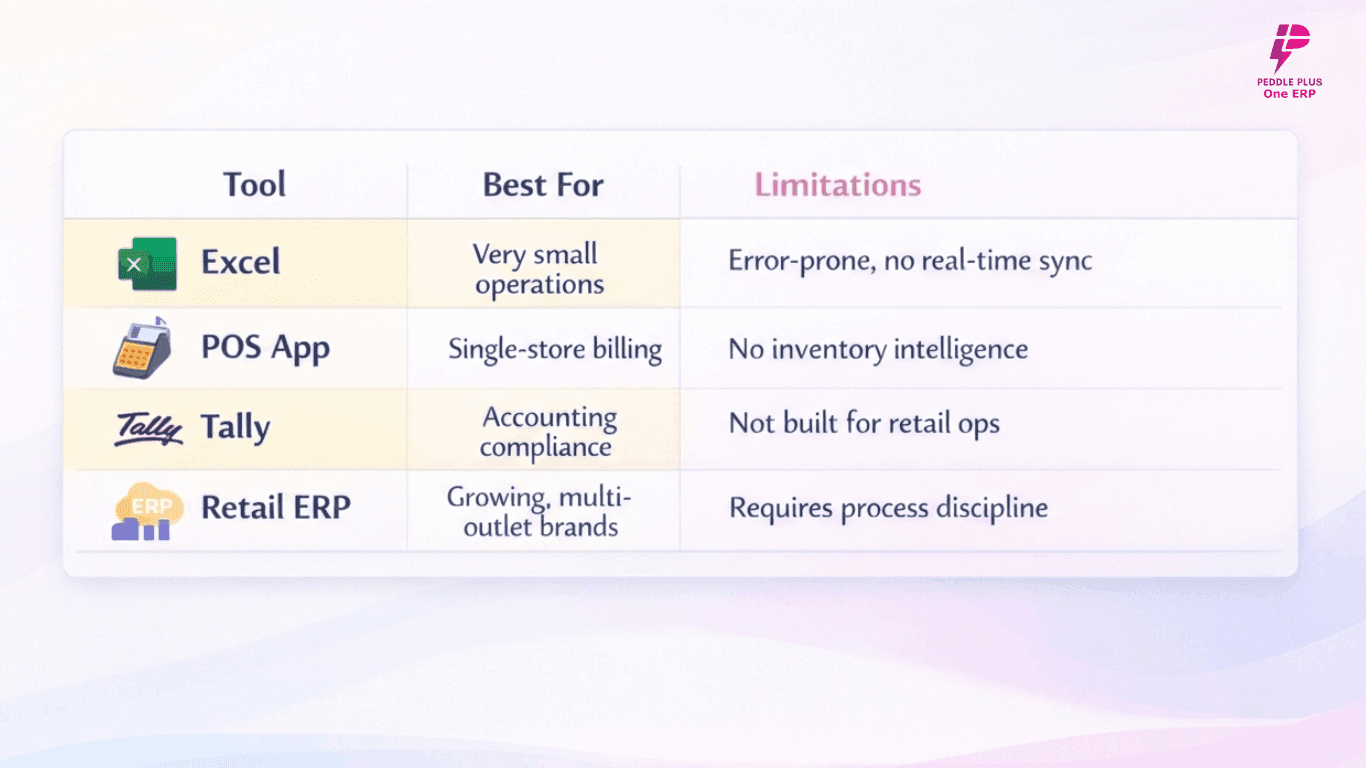
ERP vs POS vs Tally vs Excel (What to Use and When)
ERP Use Cases by Retail Business Type
ERP for Multi-Outlet Retail Brands
Central price & discount control
Outlet-wise profitability
Franchise performance tracking
ERP for Distributors & Wholesalers
Credit cycle visibility
Batch & expiry management
Territory-wise sales reporting
ERP for Category-Focused Brands (Fashion, FMCG, Pharma)
Size/variant tracking
Seasonal demand forecasting
Margin-level analytics
ERP adapts to business models, not the other way around.
What Decision-Makers Should Evaluate Before Choosing ERP
For founders, CFOs, and consultants, the right ERP decision hinges on:
Scalability across cities and outlets
GST-readiness for future compliance
Inventory intelligence (not just counts)
Ease of adoption by store teams
Data security and cloud reliability
This is where platforms like Peddle Plus One ERP are often evaluated not as billing tools, but as operational control systems built for Indian retail complexity.
Final Perspective: ERP Is a Leadership Decision in 2026
Indian retail is entering a phase where scale without systems is a liability.
ERP adoption in 2026 is not about software; it is about visibility, discipline, and predictable growth.
Retail leaders who invest in operational clarity today will control margins tomorrow.
For brands evaluating modern ERP systems for Indian retail, exploring platforms purpose-built for local workflows, such as Retail ERP solutions designed for GST, inventory intelligence, and multi-outlet control, can be a practical next step.
Frequently Asked Questions
Is ERP suitable for growing retail brands in India?
Yes. ERP is designed for businesses scaling across outlets, SKUs, and regions, not for single-store operations.
Can ERP replace POS and accounting software?
Retail ERP integrates POS, inventory, and GST workflows while complementing accounting systems.

Tamanna Bhardwaj
EditorContent Strategist at Peddle Plus with 4+ years of experience in brand growth and marketing, specializing in retail technology, ERP adoption, and business operations for Indian SMEs.